
How to Renovate an Occupied Office Without Major Construction
An office can look tired long before its walls, doors, and glass stop functioning. A full build-out may be hard to justify when teams still occupy the space, leases are uncertain, or capital budgets are tight. Surface-based upgrades can change what employees and visitors see without rebuilding everything behind the finish.

Begin with the visible problems
Walk the space as an employee or visitor would. Note worn entry doors, blank reception walls, inconsistent conference-room privacy, dated glass patterns, confusing wayfinding, damaged finishes, and common areas that no longer reflect the company. Prioritize the surfaces that affect first impressions, privacy, navigation, and daily use.
Use the surfaces already in place
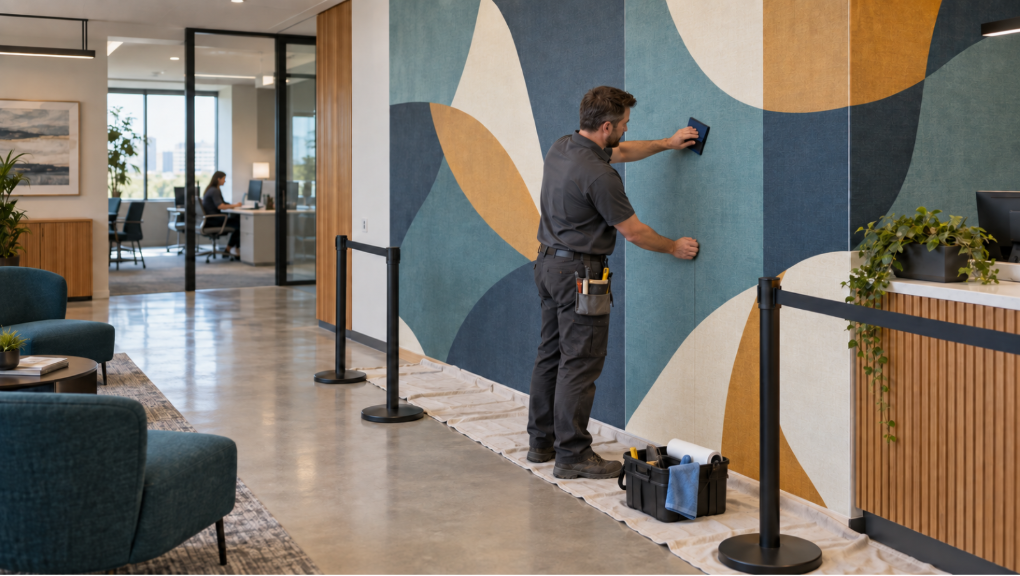
Existing glass can receive decorative, gradient, custom printed, solar-control, or specialty film. Smooth walls can become custom murals, branded timelines, writable collaboration surfaces, or durable wallcovering. Suitable doors, millwork, and other rigid surfaces can be refreshed with architectural film. Keeping serviceable substrates reduces the need for demolition and replacement.
Plan around occupancy
Occupied work changes the installation plan. Identify noise restrictions, security areas, employee schedules, furniture moves, ventilation needs, floor protection, loading access, and after-hours rules. Break the work into zones that can be completed and reopened instead of disrupting an entire floor at once.
Coordinate the design across materials
A refresh can look pieced together when every surface is treated as a separate purchase. Start with a simple visual system: color palette, pattern language, brand elements, privacy level, finish family, and wayfinding hierarchy. Then decide which material best carries each part of that system.
Set realistic expectations for existing conditions
Films and wallcoverings improve appearance, but they do not repair unstable substrates. Damaged drywall, moisture, peeling paint, failing veneer, loose sealant, or poorly operating doors may need correction first. A field survey identifies prep work and prevents the finish installation from becoming the moment hidden conditions are discovered.
Measure the result
Define the business reason for the refresh before selecting products. The goal may be a more credible client-facing space, better privacy, improved navigation, faster turnover of a tenant suite, or a consistent brand across several locations. Clear priorities help the team spend money on the surfaces that will make the most visible difference.
Planning Questions to Ask Early
- Which visible conditions are hurting privacy, navigation, employee use, or client perception?
- What work hours and phasing rules will keep the office operating?
- Which existing substrates are stable enough to receive a new finish?
Why MetWest Fits This Scope
MetWest can coordinate glass film, wallcovering, graphics, writable surfaces, and architectural surface film as one visual program. A single field and production team reduces handoffs and helps facility managers phase the work around an occupied office.
No Comments