
The Designer’s Guide to Writable Wall Coverings
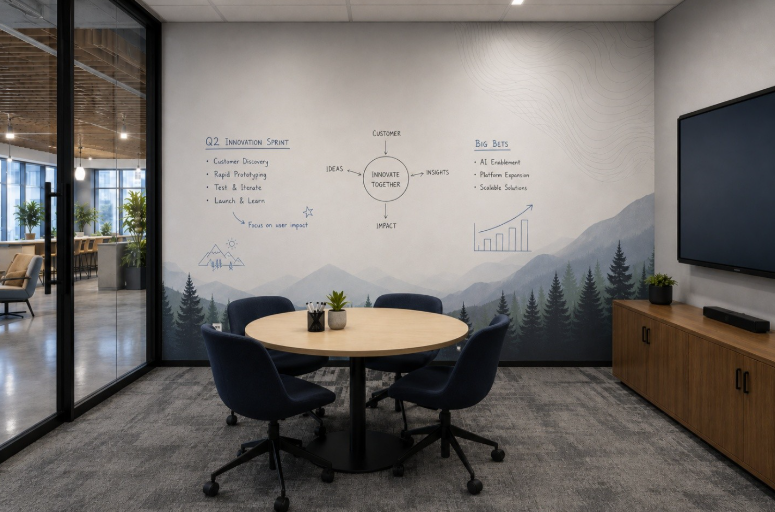
Collaboration is the new competitive advantage — and the spaces that enable it have become a critical part of commercial interior design. Writable wall coverings sit at the intersection of function and design, turning any wall into a canvas for ideas while keeping the space visually cohesive and on-brand.
Here’s what every interior designer should know before specifying writable surfaces.
What Are Writable Wall Coverings?
Writable wall coverings (also called dry-erase wall coverings or whiteboard wall coverings) are applied to existing walls and turn them into large-format, writable surfaces. Unlike traditional whiteboards, they can be printed with custom graphics, patterns, or branding — so the wall looks intentional and designed, not like a whiteboard bolted to a wall as an afterthought.
MetWest’s Peerhatch writable wall covering is a premium dry-erase surface that can be custom-printed with any design. It’s erasable, non-ghosting, and made for commercial-grade use.
Design Applications
- Huddle rooms and small conference spaces — turn an entire wall into a working surface
- Open plan areas — create visual wayfinding while adding utility
- Reception areas — display brand messaging that teams can update in real time
- Training rooms — replace fixed whiteboards with full-wall writable coverage
- Creative studios — give teams the freedom to sketch, diagram, and ideate at scale
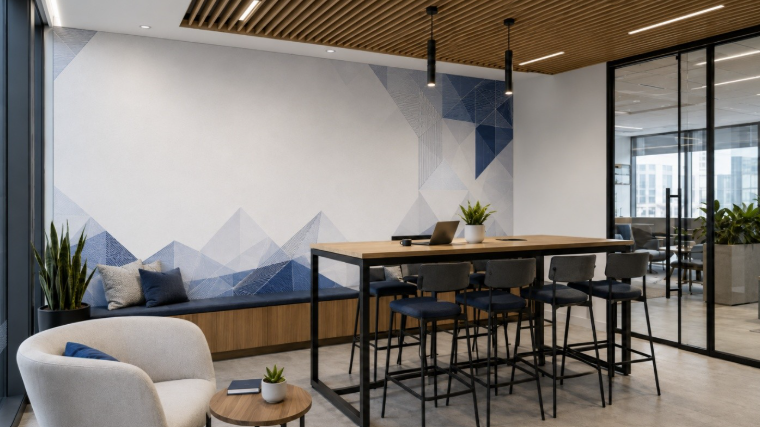
How Peerhatch Compares to Traditional Whiteboards
Traditional whiteboards are bulky, fixed, and limited in size. They’re also expensive to specify in custom sizes and impossible to brand. Peerhatch writable wall coverings offer:
- Unlimited size — cover an entire wall seamlessly
- Custom print — any design, any color, any brand element
- Easy cleaning — just wipe with a microfiber cloth
- Reusable surface — designed for years of commercial use
- Faster installation — applied like a wall covering, not mounted like a board
No Comments