
Decorative Resin Panels vs. Custom Printed Film for Glass
Decorative resin panels can create depth, color, and organic texture, but they also introduce panel fabrication, edge finishing, support details, lead time, and material waste. When the design intent is primarily visual, custom printed film on existing glass may achieve a similar effect with a different construction and cost profile.
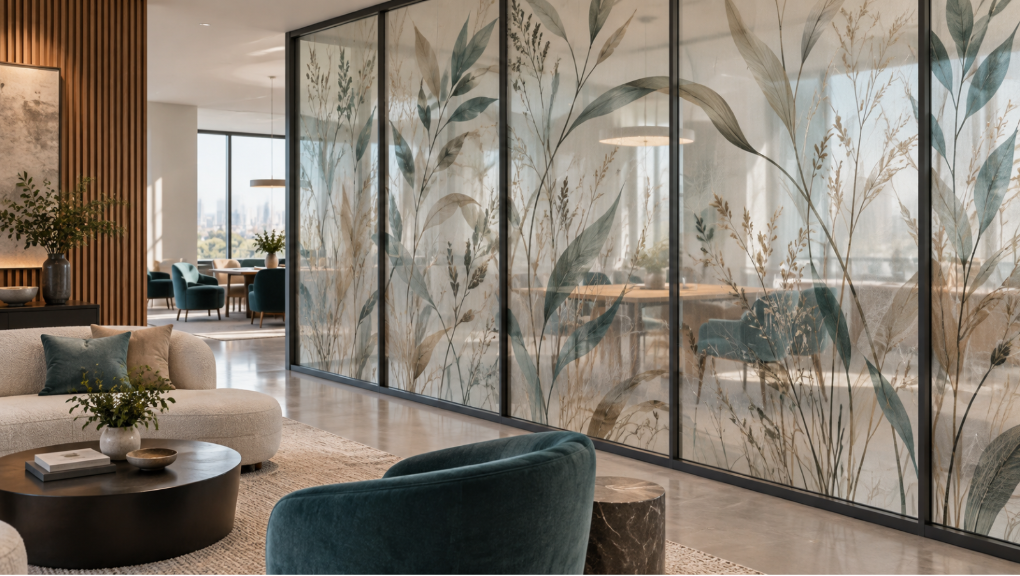
Compare the intended effect
Resin is a physical panel with thickness and depth. Printed film is a surface graphic. If the design depends on dimensional edges, embedded material, rigidity, or the panel acting as the substrate, film is not a direct replacement. If the goal is the appearance of layered botanicals, fibers, textures, or translucent graphics on existing glass, film may be a practical alternative.
Use existing glass
Film can transform glass already included in the project rather than adding a second fabricated panel system. That may reduce structural coordination, panel handling, edge finishing, freight, and offcut waste. The installer still needs accurate dimensions, suitable glass, approved artwork, and access to each lite.
Customize without stock-size limits
A printed design can be scaled and mapped to the actual elevations. Pattern density, color, clear areas, repetition, and alignment can be changed for the project rather than dictated by a stock sheet. This is particularly useful when the graphic must continue across several panes or respond to doors, mullions, and sightlines.
Review transparency and depth honestly
A printed film will not create the same physical depth as material embedded inside a thick resin panel. Samples should be viewed on glass in the intended lighting and from normal distances. The comparison should focus on whether the alternative satisfies the design goal, not whether two fundamentally different materials look identical at close range.
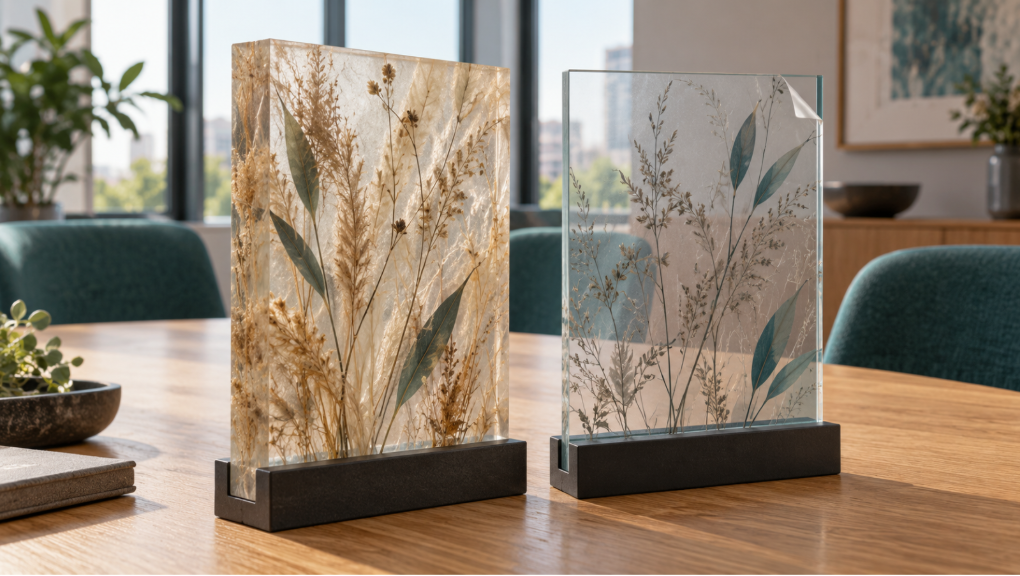
Compare total installed scope
Evaluate fabrication, finishing, freight, installation, substrate requirements, waste, replacement, and lead time – not only the material price. A film alternative is most compelling when it preserves existing glass, reduces custom fabrication, and still delivers the approved visual result.
Planning Questions to Ask Early
- Is physical depth essential, or is the pattern and translucency the main objective?
- Can the design be translated into production-ready artwork for the actual glass elevations?
- Has the comparison included fabrication, freight, installation, support details, and waste?
Why MetWest Fits This Scope
MetWest can help translate a material-inspired concept into custom artwork, develop elevations and strike-offs, and install the approved graphic on existing glass. The design team can review the real effect before changing the specified construction approach.
No Comments