
Cloaking Film for Conference Rooms: Privacy for Screens Without Closing Off the Space
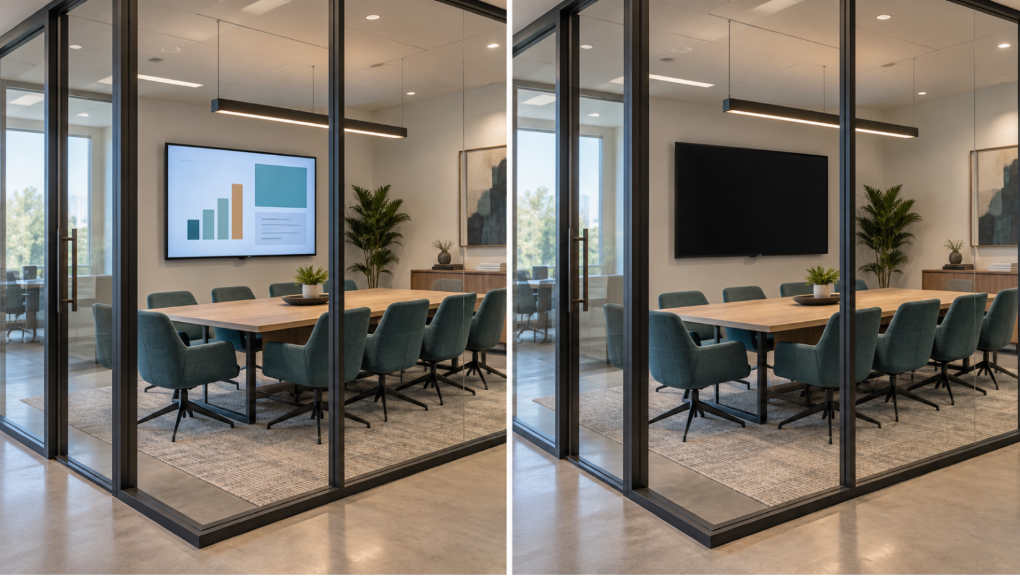
Glass conference rooms support daylight and an open office, but presentation screens can expose financial results, employee information, product plans, or client material to anyone walking past. Cloaking film is designed to reduce the visibility of compatible screen content through the glass without turning the entire room opaque.
What cloaking film actually hides
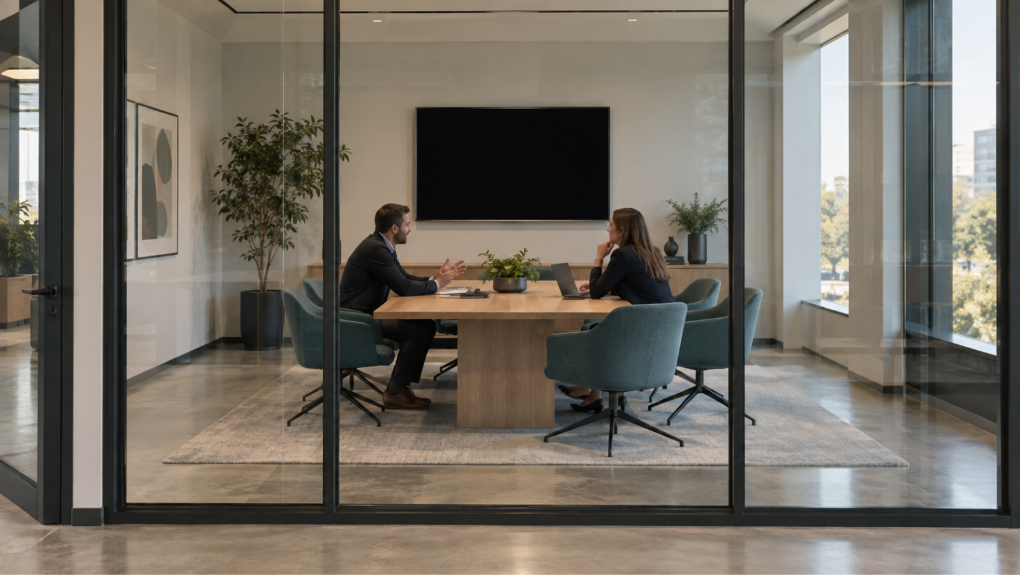
Cloaking film targets the light produced by certain display technologies so the screen appears dark or blank when viewed through treated glass. It does not make the room private. People, furniture, whiteboards, paper documents, and anything else in the room may remain visible.
Compatibility comes first
The effect depends on the display, glass, film orientation, viewing angle, and installation. Not every monitor or screen will produce the intended result. Confirm the exact display model and test a physical sample or mockup before the design is approved. Replacing the screen later may also change performance.
Plan the coverage
Some projects cover the full glass wall while others treat only the viewing zone around the screen. Full coverage creates a more uniform appearance, but partial coverage may reduce material and preserve untreated views. Elevations should show film limits, seams, doors, sidelites, mullions, and the screen location.
Coordinate with the room design
Cloaking film can be combined with decorative bands, gradients, or distraction markers, but every added layer changes the visual result. The design team should coordinate film, screen placement, conference-room lighting, camera positions, and furniture before finalizing the glass elevations.
Set the right expectation
Cloaking film is a focused visual-privacy tool, not a replacement for information-security practices. Teams should still control access, lock devices, manage screen sharing, and avoid leaving sensitive material visible on whiteboards or tables.
Planning Questions to Ask Early
- Has the exact display been tested with the selected cloaking film?
- Should the film cover the entire glass wall or only the screen viewing zone?
- Does the room need screen privacy, general visual privacy, or both?
Why MetWest Fits This Scope
MetWest can review the glass and display arrangement, provide samples, develop elevations, coordinate decorative elements, and install the approved film. Testing the actual condition early prevents the team from discovering a display compatibility problem after the room is complete.
Ready for a quote? Get an estimate – MetWest
No Comments