
Security Film, Privacy Film, and Printed Film for Schools: What Each One Actually Does
Schools often ask for one glass product to improve safety, reduce visibility, add school identity, and support everyday use. Those goals are related, but the films that address them are not interchangeable. A clear scope begins by separating physical glass retention from visual privacy and printed communication.

Security film manages broken glass
Security film is designed to help hold broken glass together as part of a tested or engineered system. The complete installation may include attachment to the frame, depending on the required performance. It does not make glass unbreakable, eliminate the need for security planning, or automatically block the view through the glass.
Privacy film changes visibility
Frosted, opaque, patterned, gradient, or reflective films can reduce views into classrooms, offices, sidelites, or entry areas. The correct product depends on whether privacy must be constant, directional, partial, or limited to a specific height. Privacy film alone should not be described as forced-entry protection.
Printed film adds information and identity
Printed film can carry school colors, mascots, wayfinding, donor recognition, patterns, or visual screening. It can make an entry more welcoming and reduce direct sightlines, but a graphic layer is not automatically a security product. If both functions are required, the assembly must be designed and approved as a combination.
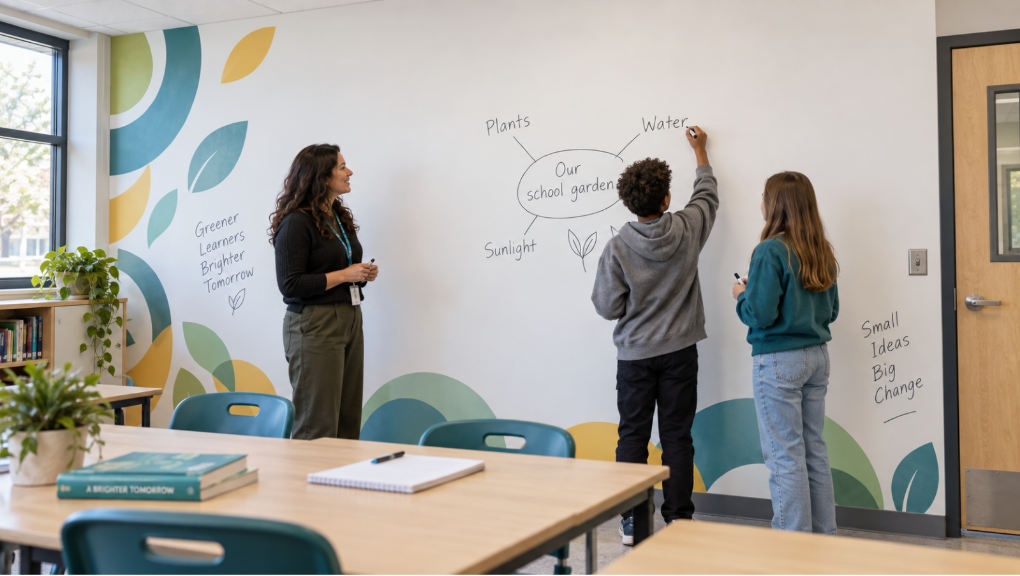
Writable surfaces serve another purpose
A printed layer can also be coordinated with a writable surface for classrooms or collaboration areas. That creates a functional communication wall, but it should remain separate from claims about glass security unless the specified system has been evaluated for that use.
Write the scope by outcome
Specifications should state the intended outcome for each opening: glass retention, forced-entry delay, privacy, distraction marking, branding, wayfinding, or writable use. Identify products, layers, attachment details, coverage, testing requirements, and responsible trades. Clear language prevents a decorative product from being mistaken for a protective system.
Planning Questions to Ask Early
- Is the priority glass retention, visual privacy, branding, writable use, or several separate outcomes?
- Does the selected security system require a perimeter attachment?
- Are product claims, testing, and installation details documented for the exact assembly?
Why MetWest Fits This Scope
MetWest can help school teams separate the performance and design requirements, coordinate samples and graphics, and develop a layered approach where appropriate. That creates a clearer scope and avoids overstating what any one film can do.
No Comments