
The Complete Guide to Glass Film Types for Commercial Spaces
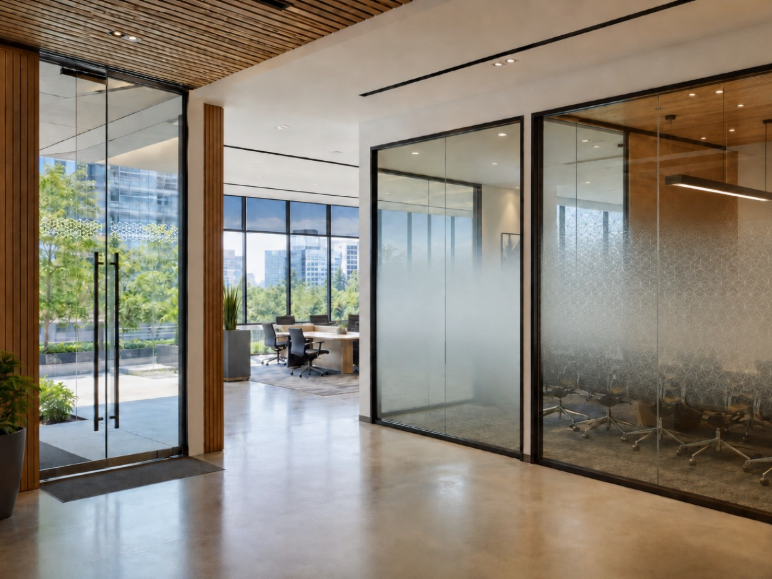
Glass film is one of the most versatile materials in commercial interior design and building management — but the category is broader than most people realize. There are five primary types of commercial glass film, each with distinct properties, applications, and installation considerations.
This guide covers all of them.
1. Decorative Glass Film
Decorative glass film is designed to enhance the visual appearance of glass surfaces. It can be:
- Frosted — a uniform matte finish that diffuses light and provides privacy
- Patterned — geometric, organic, or custom patterns printed or etched into the film
- Custom printed — photography, logos, artwork, or brand graphics applied to glass
- Translucent color — colored films that tint glass without fully blocking light
Best for: Conference rooms, reception areas, office partitions, branded environments, retail storefronts.
2. Gradient Glass Film
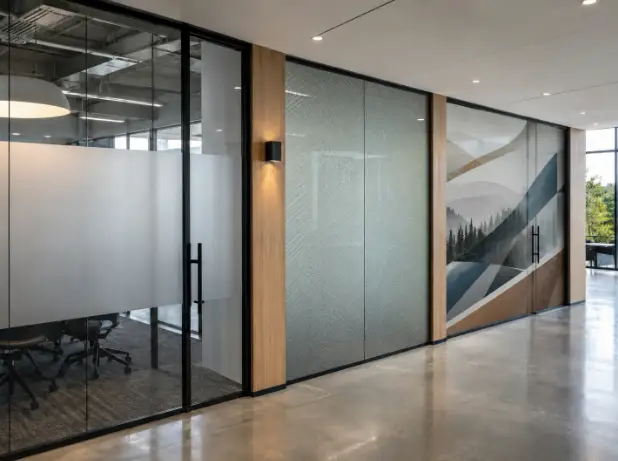
Gradient film transitions smoothly from opaque or frosted at one end to completely clear at the other. The transition can be linear (top-to-bottom or side-to-side) or custom-shaped. Gradient film is a premium, design-forward option that reads as an architectural element rather than a utilitarian covering.
Best for: Conference rooms, executive offices, healthcare waiting areas, high-design commercial interiors.
3. Commercial Security Film
Security film is a thick polyester film (typically 4–12 mil) that holds broken glass fragments in place after impact. It doesn’t prevent glass from breaking, but it significantly slows forced entry and prevents dangerous glass scatter.
Security film is available in clear or slightly tinted options and is virtually invisible when installed.
Best for: Ground-floor lobbies, retail storefronts, parking structures, areas with high security exposure.
4. Solar Control Film
Solar control film selectively blocks infrared radiation (heat) and ultraviolet light while allowing visible light to pass through. It reduces solar heat gain, glare, and UV damage to interior furnishings.
Solar control film is available in a range of visible light transmission levels — from nearly clear to significantly tinted — depending on the desired balance of heat rejection and transparency.
Best for: South- and west-facing facades, buildings with high cooling costs, spaces where glare interferes with work.
5. Distraction Markers and Custom Bands
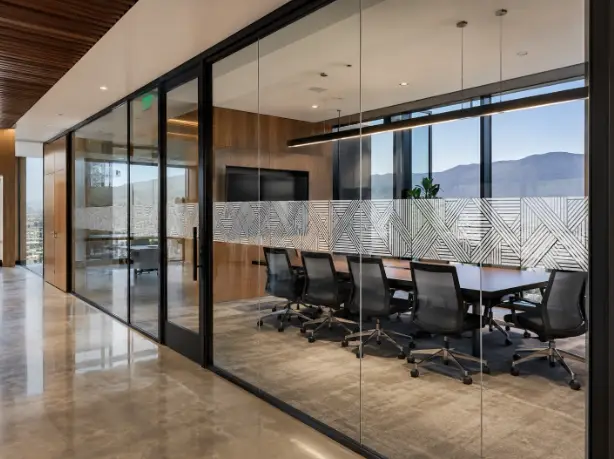
IBC and ADA building codes require visual markers on large glazed surfaces — floor-to-ceiling glass walls, glass doors, and glazed partitions — to prevent accidental impact. Traditional distraction markers are simple dots or bands, but custom film allows designers to meet the code requirement with branded graphics, patterns, or decorative bands that contribute to the design rather than interrupting it.
Best for: Any project with large glazed surfaces in occupied spaces — offices, lobbies, healthcare, education.
Choosing the Right Film for Your Project
Many commercial projects use multiple film types — solar control on exterior glazing, decorative film on interior partitions, and security film on ground-floor entry glass. MetWest’s specification team can help you navigate the options and select the right product for each application.
No Comments