
What Contractors Need to Know About Glass Film Installation Timelines
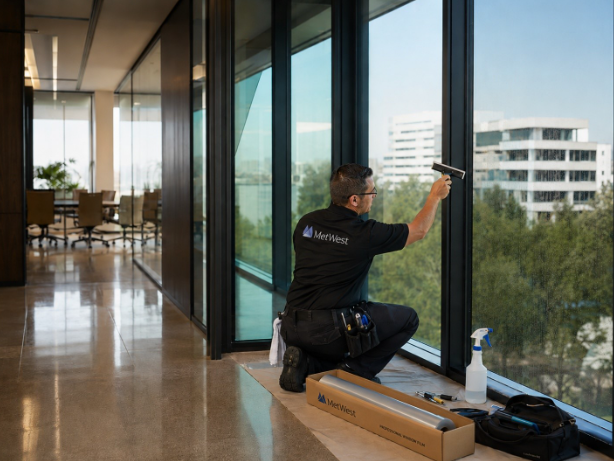
When a designer specifies glass film on your project, your job is to make sure it gets installed on time, on budget, and without disrupting other trades. That requires understanding how glass film installation actually works — from the moment the spec hits your desk to the day the crew wraps up.
Here’s a clear-eyed look at the timeline and what you can do to keep things moving.
The MetWest Process: Phase by Phase
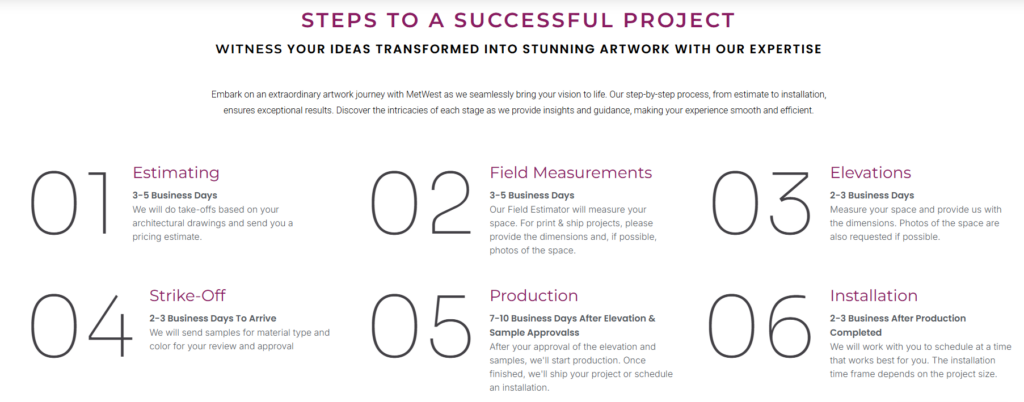
Once MetWest is engaged on a project, here’s what the timeline looks like:
- Estimating: 3–5 business days from receipt of architectural drawings
- Field measurement: 3–5 business days — our field estimator visits the site to verify dimensions
- Elevation approval: 2–3 business days for MetWest to produce and submit elevations
- Sample approval (strike-off): 2–3 business days after samples ship
- Production: 7–10 business days after elevation and sample approvals are received
- Installation: scheduled before production begins
Where Delays Happen — And How to Prevent Them
The most common causes of schedule slippage on glass film projects:
- Late drawing delivery — the clock doesn’t start until MetWest has accurate drawings. Share drawings as early as possible, even if the design isn’t 100% finalized
- Slow sample approvals — the designer or end-client needs to approve strike-offs before production starts.
- Site access conflicts — glass film is installed after painting and flooring, but access conflicts with other trades can push installation.
- Substrate issues — if glass surfaces are not ready or the caulk is not dry, installation may be delayed. MetWest’s field visit will flag these in advance
Print-and-Ship vs. Full-Service Installation
For some projects, MetWest ships finished film panels to the jobsite for installation by your own crew or a local sub. For others, MetWest crews handle full installation. The choice affects your timeline and budget:
- Print and ship: faster for simple, flat applications; requires your crew to have glass film experience
- Full service: MetWest manages quality and installation precision; ideal for complex or custom applications
Discuss this with your MetWest rep early — the decision affects production packaging and field logistics.
Communicating with the Design Team
As the contractor, you’re the bridge between the designer’s specification and MetWest’s execution. Make sure you have:
- A copy of the designer’s glass film specification and elevation drawings
- Direct contact information for the MetWest project manager
- A clear understanding of who approves strike-offs (designer, client, or both)
No Comments